«Lavandenewa»
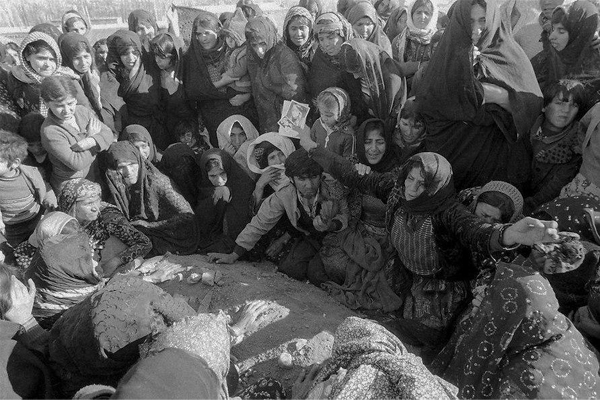
«Lavandenewa» is one of the oldest and most significant forms within the oral tradition of Kurdistan. It is a genre of improvised lament poetry performed by women—especially mothers, sisters, and close female relatives of the deceased—during mourning rituals in private homes, along funeral routes, or at gravesides. Unlike written elegies or pre-composed liturgical texts, «Lavandenewa» emerges spontaneously, shaped in the moment by the emotional state of the performer, the composition of the audience, and the political circumstances in which the death occurred.
In the 1980s and the years following the 1979 Iranian Revolution, when Kurdistan faced extensive military attacks, widespread repression, mass arrests, summary executions, and enforced disappearances, this genre became far more than a mourning practice. It functioned as a public communicative medium—an improvised, women-led channel for transmitting news, identifying victims, naming perpetrators, and resisting the erasure of truth at a time when no independent press existed and when public grief itself was surveilled or punished.
Historical Context: Media Suppression and the Emergence of a Women’s Public Sphere
Following the 28 Mordad 1358 (19 August 1979) military assault on Kurdistan and the arrival of Sadeq Khalkhali—the cleric appointed as head of the Revolutionary Courts—political repression intensified dramatically. This period saw widespread arrests, mass executions without trial, secret burials, removal of grave markers, bans on public mourning, restrictions on gathering, and the complete absence of independent media.
In this environment, even grieving publicly could be interpreted as political protest. Families who attempted to announce or memorialize deaths risked harassment or further punishment. With formal public space eliminated, private homes and cemeteries became the only semi-safe arenas where people could gather, exchange information, and maintain communal ties. These gatherings—rituals of mourning that the state could not fully control—became the heart of a new, women-led, oral public sphere.
Why «Lavandenewa» Became a Medium of Communication
1. Improvised Form, Direct Ties to Events
Because «Lavandenewa» is created spontaneously, it mirrors specific real-world events. This immediacy allowed mothers to embed crucial information: names or kinship of executed individuals, exact locations, timelines, physical signs of violence, and names of perpetrators.
2. Moral Authority of a Mourning Mother
The voice of a grieving Kurdish mother carries deep moral legitimacy and cannot easily be dismissed.
3. Musical Structure and Oral Transmission
Repetition and rhythm enable quick memorization, allowing poems to circulate orally as a grassroots news network.
4. Independence from Technology
«Lavandenewa» required no equipment at a time when print and broadcast media were controlled by the state.
What «Lavandenewa» Preserved and Transmitted
«Lavandenewa» preserved forms of information that no written records captured:
- Names and identities of victims
- Exact locations of violence (garrisons, prisons, roads)
- Event-based timelines (“night of the firing squad”)
- Names of perpetrators (Khalkhali, Sepah forces, Jash collaborators)
- Physical signs of violence (number of bullets, condition of the body)
- Practical information about prison visits, transfers, burial sites
Case Study I: Daye Behiye Kohne-Pushi
Daye Behiye is one of the most recognized women whose «Lavandenewa» circulated widely during the first waves of executions in 1979–1980. Her poems are preserved through handwritten transcriptions by her daughter, Maleke Mostafa Soltani.
Original (Sorani Kurdish):
Min dilim naye têr shintan bikem
Fouad gyan, khosh be le jênshitân
Xalxali hatûwe be welat-da
Rôle juwanekan abat le zakat-da
Hey dad, hey bedad
Yekhsîr-keshekan padganem ro
Dayk î‘damîyekan chîye halyân
Agher debarê le dewrê mâlyân
Dayk î‘damîyekan ben bo dukanem
Hewal aw-kôsta, min bash dezânem
English Translation (Poetic):
My heart cannot bear to deepen your sorrow.
Fouad, beloved one, may you be the comfort for these wounds.
Khalkhali has come into our land,
taking our young ones as though they were alms to be offered.
O justice—where have you gone? O injustice—how heavy you fall.
Where have they taken the captives from the garrison?
How are the mothers of the executed enduring today?
It is as if fire is raining down upon their homes.
Mothers of the executed, come to my house—
the news is bitter water, but I know its taste well.
Case Study II: Daye Aishe Hajji Mirza’i and the Sanandaj Cassette
Rare audio recordings made by Huriye Ghamian preserve «Lavandenewa» performances from the 1980s. Only one 50-minute cassette survives today.
English Rendering (based on family testimony):
O my heart, clouded like spring water turned dark—
Hamid wanders, searching for you.
The wound of Kak Karim has not yet healed,
and now the wound of Hamid is added to it.
If only I had known the day you died—
I would have come and wrapped my arms around your neck.
Where shall I go now? Whom shall I look for
whose face resembles yours?
Mother would give her life for your courage.
Sister would give her life for your suffering.
Do not go, Hamid, toward Chamsu,
the enemy waits for you there.
You are my only hope, my only child—
all that remains for me in this life.
Footnotes
- 28 Mordad 1358: The date of a major Iranian military assault on Kurdistan.
- Sadeq Khalkhali: Head of Revolutionary Courts; responsible for mass executions.
- Sepah: Islamic Revolutionary Guard Corps.
- Jash: Kurdish term for local collaborators with the state.
- “Khalkhali has come into our land”: Indicates the start of summary executions.
- “Alms (zakat)”: Religious metaphor criticizing justification of violence.
- “Garrison”: Primary site of early executions.
- “Bitter water”: Kurdish idiom meaning painful truth.
- Kak Karim: Aishe’s brother, executed in Evin Prison.
- Chamsu: Village known for ambushes and military conflict.


Daye Aishe Haji Mirzaei, Sanandaj
A selection of Daye Aishe’s lavandenewa (women’s improvised lament poetry) performed during a mourning ceremony in Sanandaj

Daye Behiye Kohne-Pushi
My heart cannot bear to deepen your sorrow. Fouad, beloved one, may you be the comfort for these wounds. Khalkhali has come into our land, taking our young ones as though they were alms to be offered. O justice—where have you gone? O injustice—how heavy you fall. Where have they taken the captives from the garrison? How are the mothers of the executed enduring today? It is as if fire is raining down upon their homes. Mothers of the executed, come to my house